
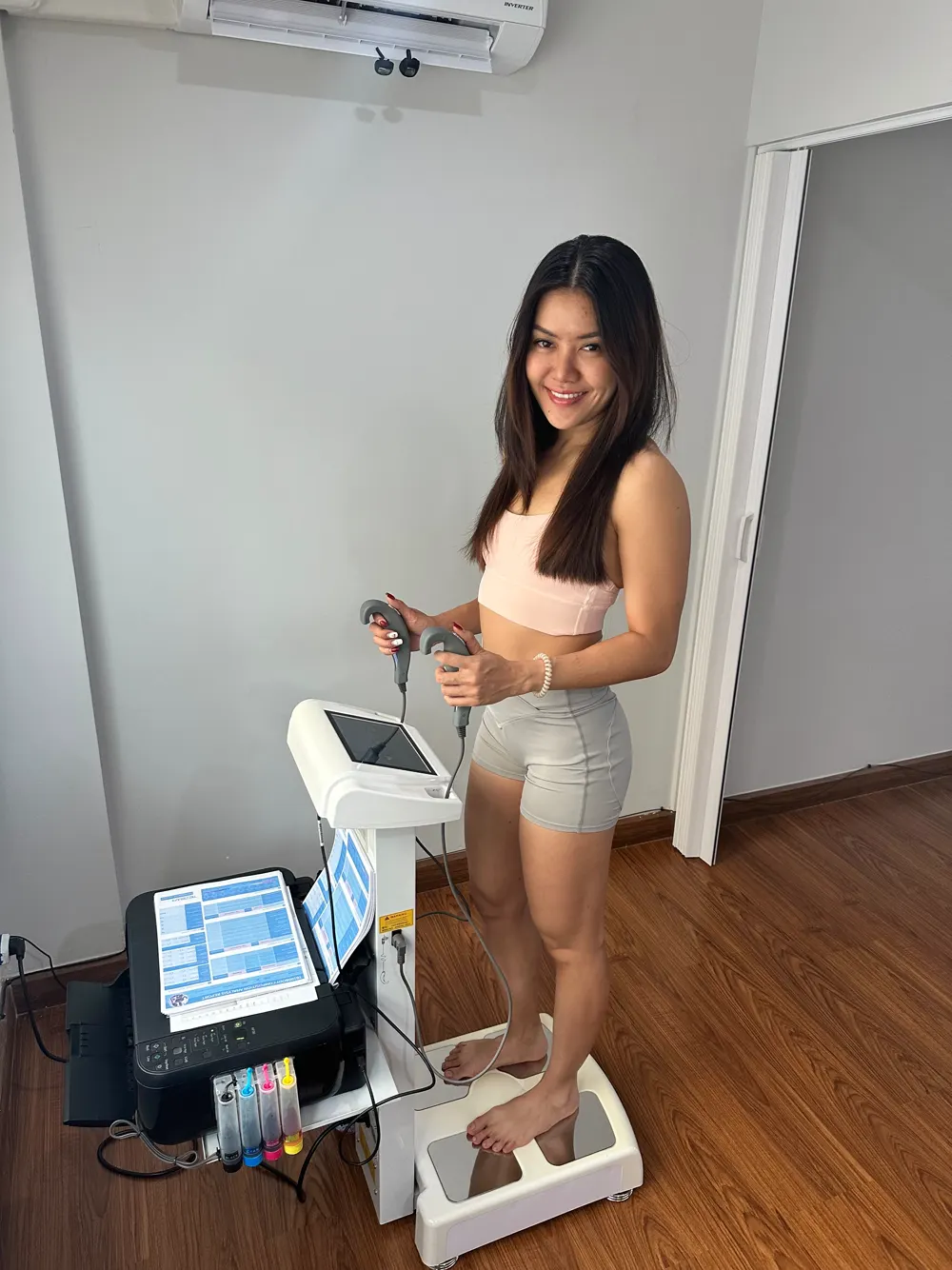
What's a good visceral fat level? Your scan number explained
You've just stepped off a body composition scanner and one line on the printout says “Visceral fat: 4.5 kg”. Is that good? Bad? What even is visceral fat?
4.9 on Google Maps
The short answer
A good visceral fat level depends on your scanner. On our Tezewa scanner, 1–5 kg is the normal range printed on the sheet. On InBody, the maker recommends a level under 10.[1] On Tanita, 1–12 is healthy.[2] All three are estimates, so watch how your number moves over several scans rather than reacting to one.
- Visceral fat is the deep fat packed around your organs inside your belly.
- Our scanner at AquaFIT shows it as an estimate in kilograms. The normal range printed on the result sheet is 1–5 kg.
- Other brands show a level instead. On InBody scanners, the maker recommends a visceral fat level under 10. At 10 and above, the risk of lifestyle-related illness such as type 2 diabetes goes up.[1]
- On Tanita scanners, 1–12 is the healthy range and 13–59 is too high.[2]
- The number is an estimate. Watch how it changes over several scans taken the same way, rather than reacting to one reading.
Visceral fat vs subcutaneous fat
Your body stores fat in two main places.
| Subcutaneous fat | Visceral fat | |
|---|---|---|
| Where it sits | Just under your skin | Deeper, inside your belly, wrapped around organs like your liver, gut and kidneys |
| Can you see it? | Yes. It's the fat you can pinch on your arms, thighs and belly. | No. You can't pinch it or see it. |
Visceral fat is the “belly fat” people worry about, but not all belly fat is visceral – the part you can pinch is subcutaneous. Someone with a slim build can still carry more of it than you'd expect. Someone with a big belly may carry a lot of it.
Both types store energy, but visceral fat behaves differently. Cleveland Clinic calls it “active fat”, because it affects how your body works, not just how it looks.[3]
What the number means
A bioimpedance scanner (one that sends a tiny, safe current through your hands and feet) can't see your organs. Instead, it uses your measurements and a formula to estimate how much visceral fat you have. Different brands then show that estimate in different ways.
Our scanner: kilograms
The Tezewa scanner we use at AquaFIT shows visceral fat as a weight in kilograms, for example “Visceral fat: 4.5 kg”. The result sheet prints a normal range of 1–5 kg next to your number. A reading inside that range is normal; above 5 kg is worth working on.
Like every reading of this kind, it's an estimate. Watch how it moves over several scans rather than reacting to one.
InBody scanners: a level
InBody calls it the Visceral Fat Level. According to InBody, each level stands for about 10 square centimetres of visceral fat, measured as if you took a slice across your belly. So level 5 means roughly 50–60 cm², and level 10 means roughly 100 cm².[1]
InBody recommends keeping your level under 10 (or your visceral fat area under 100 cm²). It says that at 10 and above, the risk of lifestyle-related illness such as type 2 diabetes goes up.[1] On older InBody software, the level stopped at 20 (about 200 cm²); newer software can show higher numbers.[4]
| InBody visceral fat level | What it means |
|---|---|
| 1–9 | Within InBody's recommended range |
| 10 or higher | Above the recommended range; worth working on and worth mentioning to your doctor |
Tanita scanners: a rating
Tanita uses a rating from 1 to 59, where 1–12 is considered healthy and 13–59 is too high.[2] Some home scales use their own scales again.
So a “4.5 kg” on our scanner, a “12” on an InBody and a “12” on a Tanita are three different things. Only compare numbers from the same machine, and read yours against the normal range printed on your own result sheet. If you're not sure, ask the person who ran your scan.
Why visceral fat matters for your health
Carrying a lot of visceral fat is linked with a higher risk of heart disease, type 2 diabetes and high cholesterol, according to Cleveland Clinic.[3] InBody also notes links with diabetes, stroke and dementia.[1] These are associations: a high reading doesn't mean you have or will get any of these. But it's a useful nudge to look after your health.
A quick check you can do at home: measure your waist at belly-button level.
Cut-offs for Asian adults are lower: about 80 cm for women and 90 cm for men (WHO Western Pacific, 2000).[5] If your scan and your tape measure both say “high”, it's a good time to talk to your doctor.

How to reduce visceral fat: what the research says
Here's the encouraging part. Visceral fat often responds well to lifestyle changes. Cleveland Clinic notes it is generally easier to lose than the fat under your skin.[3]
Regular exercise helps, even before the scale moves much. A 2013 review of 15 studies with 852 adults carrying extra weight found that exercise reduced visceral fat even without a diet.[6] Moderate to hard aerobic exercise (the kind that gets you breathing harder, like brisk cycling) worked best. Very easy exercise didn't make a clear difference.[6]
What you eat matters too. Cleveland Clinic points to eating patterns like the Mediterranean diet, and to cutting back on sugary foods and drinks and on alcohol.[3] You don't need a crash diet. Small, steady changes you can keep are what count.
Sleep and stress play a part. Short sleep and long-term stress make visceral fat harder to shift, according to the same source.
Expect weeks to months, not days. Everyone is different, so we won't put a number on it. Re-check every few weeks, not every few days.
If sore knees or hips have stopped you exercising, low-impact options like cycling in water let you work hard without pounding your joints. Read more about private aqua cycling or our low-impact weight loss programme.
Why one reading isn't gospel
Your visceral fat number is a best guess, not a measurement of the real thing. Only a CT or MRI scan in hospital can actually measure visceral fat, and InBody itself calls direct imaging like CT the gold standard.[1] Your reading can also move for reasons that have nothing to do with fat:
Water
Being dehydrated, or having just drunk a lot, shifts the reading.
Food
A big meal in the last couple of hours can change it.
Exercise, sauna or a hot bath
All of these move water around your body. Scan before, not after.
Time of day
Morning and evening readings can differ.
Your period
Body water shifts during the menstrual cycle.
Different machines
As above, brands use different scales and formulas.
The fix is simple: scan under the same conditions each time (same machine, before exercise, similar food and drink). Then look at the trend across several scans. A steady drop over a couple of months tells you far more than one high or low number.
Check with your doctor first if…
Your visceral fat number is not a diagnosis. Talk to your doctor if your reading is high. That matters most if you also have a large waist, high blood pressure, high blood sugar or a family history of heart disease.

Get your visceral fat checked in Chiang Mai
Live in or around Chiang Mai? At AquaFIT Spabike Center in Chiang Mai, we run a body composition scan that estimates your body fat, muscle and visceral fat. Then we explain every number in plain English. We always scan before exercise, so your results are fair to compare from visit to visit. Plenty of parking. See our prices and packages.
Book your scan, or a first visit with a scan, a 30-minute ride and a 30-minute infrared sauna.
What riders say
“This was my first time using the service. They weighed me and checked my body fat percentage. A staff member explained how to interpret the results and discussed my weight loss goals.
The spa bike exercise machine was a great experience. There were fun workout videos to follow, and a staff member guided me from the beginning. ❤️ It was tiring but not too strenuous, just right.
There was also a sauna for about 30 minutes. There were shower rooms available if I needed to go out afterwards.
There was ample parking. I recommend making a reservation in advance.”
“The place is clean, the service is friendly, and they provide excellent care and follow-up.”
“It was my first time there. The reception staff were excellent, the service was great, they explained and took care of every step. The workout, although tiring, was a lot of fun. I highly recommend it!”
Questions
Anything else? Message us on LINE – we reply in Thai or English.
What is a good visceral fat level?
It depends on the machine. Our scanner shows visceral fat in kilograms, and its normal range is 1–5 kg. InBody scanners show a level, where under 10 is recommended.[1] Tanita scanners show a rating, where 1–12 is healthy.[2] Always check the range printed on your own result sheet.
Is a visceral fat level of 12 bad?
On an InBody, 12 is above the recommended range[1], so it's worth working on and mentioning to your doctor. On a Tanita, 12 is still inside the healthy range.[2] That's why the brand matters. Our scanner doesn't use levels: it shows kilograms, with a normal range of 1–5 kg.
Can I lose visceral fat without losing weight?
Research suggests regular moderate to hard exercise can reduce visceral fat even when the scale barely moves.[6] That's one reason a body composition scan is more useful than a normal scale.
How accurate is visceral fat on a scale?
It's an estimate. Hospital CT or MRI is the gold standard. A bioimpedance reading is best used to follow your own trend over time, on the same machine.
How often should I check my visceral fat?
Every few weeks is plenty. It changes slowly, so frequent scans mostly show day-to-day water changes. At AquaFIT we re-scan every 5 visits.
Sources
- Result Sheet Interpretation. InBody.
- How is visceral fat measured by TANITA? Tanita.
- Visceral Fat. Cleveland Clinic.
- Visceral Fat Levels – InBody Update. InBody USA.
- WHO Western Pacific Region (2000). The Asia-Pacific perspective: redefining obesity and its treatment. World Health Organization.
- Vissers D. et al. (2013). The Effect of Exercise on Visceral Adipose Tissue in Overweight Adults: A Systematic Review and Meta-Analysis. PLoS One.